


If your goal is to pass the NCLEX in 2026, understanding the Next Generation NCLEX (NGN) is essential — and you’re probably wondering:
- Is it harder?
- What changed?
- How do I actually pass it?
Here’s the truth most people won’t tell you:
👉 The NGN is not harder — it’s just testing a different skill.
👉 And once you understand how it works, you can use it to your advantage.
In this complete guide, you’ll learn everything you need to know about the NCLEX NGN, including:
- The exact exam format
- All NGN question types
- How the scoring system works (explained simply)
- Why students fail
- Proven strategies to pass on your first attempt
What Is the NCLEX NGN?
The Next Generation NCLEX (NGN) is a redesigned version of the NCLEX exam that focuses on clinical judgment and decision-making, rather than simple memorization.
The National Council of State Boards of Nursing (NCSBN) introduced NGN to better evaluate whether candidates can:
Respond to real-life nursing scenarios
Make safe clinical decisions
Prioritize patient care
Interpret patient data
Why Was NGN Introduced?
Research showed that new nurses struggled with:
- Clinical reasoning
- Decision-making under pressure
- Applying theoretical knowledge in real situations
So instead of asking:
“What is the correct answer?”
The NGN asks:
“What would you do as a nurse in this situation?”
NCLEX NGN Exam Format (2026)
Understanding the format is the first step to passing.
⏱️ Time Limit
- Maximum: 5 hours
- Includes:
- Optional breaks
- Tutorial time
🔢 Number of Questions
- Minimum: 85 questions
- Maximum: 150 questions
👉 The exam is adaptive (CAT — Computer Adaptive Testing), meaning: The difficulty adjusts based on your performance
🧩 Types of Questions on the NGN
The NGN includes both traditional questions and new interactive formats.
1. 🩺 Case Study Questions (Most Important)
These are the core of the NGN exam.
Each case study presents:
- Patient history
- Vital signs
- Lab results
- Symptoms
- Ongoing updates
You’ll answer multiple questions based on one patient scenario.
Why They Matter:
- They test real nursing decisions
- They carry significant weight in scoring
- They require critical thinking, not memorization
2. ✔️ Multiple Response (SATA – Select All That Apply)
Still present, but now improved.
👉 The key difference:
- You now get partial credit
3. 🔢 Ordered Response (Drag-and-Drop)
You’ll:
- Arrange steps in the correct sequence
- Prioritize actions
Example:
Arrange the steps for administering medication safely.
4. 📊 Matrix/Grid Questions
You may be asked to:
- Match symptoms → conditions
- Match interventions → outcomes
5. 🧮 Cloze (Fill-in-the-Blank)
Often used for:
- Dosage calculations
- Clinical reasoning
6. Traditional Questions (Still Included)
- Multiple choice
- Basic nursing knowledge
👉 But now they’re more scenario-based
NCLEX NGN Scoring System (Simplified)
This is where many students get confused — so let’s break it down clearly.
🧠 Old NCLEX Scoring:
- All-or-nothing
- One mistake = zero points
✅ NGN Scoring:
👉 Uses partial credit scoring
What This Means:
- You can earn points even if your answer is not fully correct
- But wrong selections can reduce your score
Example:
A question has 5 correct options:
- You select 3 correct → partial credit
- You select wrong options → points may be deducted
⚠️ Key Strategy:
👉 Only choose answers you are confident in
👉 Avoid random guessing
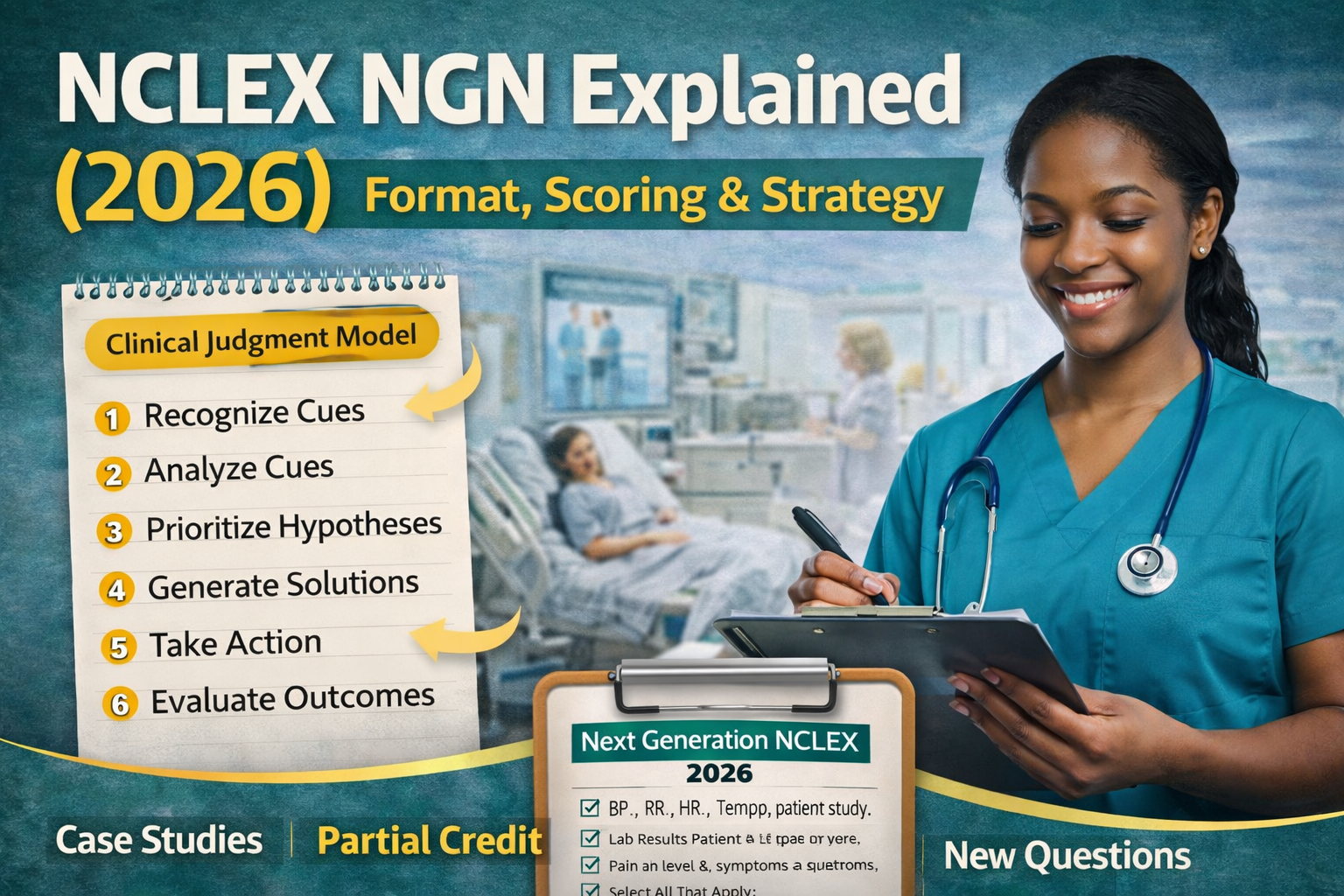
The Clinical Judgment Model (The Core of NGN)
Every NGN question is based on this framework:
1. Recognize Cues
Identify important patient data
(e.g., abnormal vitals, symptoms)
2. Analyze Cues
Understand what the data means
3. Prioritize Hypotheses
What is the most urgent issue?
4. Generate Solutions
What actions should you take?
5. Take Action
Implement the best intervention
6. Evaluate Outcomes
Did the intervention work?
👉 If you master this process, you can answer almost any NGN question.
Why Students Fail the NCLEX NGN
Let’s be honest — most students fail for predictable reasons.
❌ 1. Relying on Memorization
NGN requires understanding, not cramming.
❌ 2. Avoiding Case Study Practice
Many students skip them because they’re long.
👉 This is one of the biggest mistakes.
❌ 3. Poor Time Management
Spending too much time on one question can hurt performance.
❌ 4. Not Reviewing Mistakes
Practice alone isn’t enough — you must analyze your errors.
❌ 5. Overthinking Simple Questions
Sometimes the correct answer is the most straightforward one.
Proven Strategy to Pass the NCLEX NGN
Here’s what actually works in 2026:
1. Practice NGN-Style Questions Daily
Use tools that simulate:
- Case studies
- Partial credit questions
- Clinical reasoning
2. Focus on Understanding (Not Memorizing)
Ask:
Why is this the correct answer?
3. Master Priority Frameworks
Know these:
- ABC (Airway, Breathing, Circulation)
- Maslow’s hierarchy
- Safety principles
4. Learn to Handle Partial Credit Questions
- Select only confident answers
- Avoid risky guesses
5. Simulate Real Exam Conditions
Practice:
Mental endurance
Full-length exams
Timed sessions
Advanced Strategy for Case Study Questions
This is where you gain the most points.
Step-by-Step Approach:
1. Read Carefully
Don’t skim — details matter.
2. Identify Key Clues
Look for:
- Abnormal labs
- Vital signs
- Symptoms
3. Ask:
What is the main problem?
4. Prioritize Safety
What could harm the patient first?
5. Choose the Best Intervention
Focus on:
- Risk reduction
- Immediate care
⏱️ Time Management Tips
You have roughly:
👉 1–2 minutes per question
Best Practices:
- Don’t get stuck
- Flag difficult questions
- Stay calm under pressure
💡 Is the NCLEX NGN Harder?
👉 No — it’s just more realistic.
If you:
- Think critically
- Practice consistently
- Understand clinical reasoning
You can pass — even on your first attempt.
📈 Best Resources to Prepare for NGN
To succeed, use tools that offer:
- NGN-style case studies
- Detailed explanations
- Performance tracking
👉 This is where many students gain an edge.
Final Tips to Pass the NCLEX
- Study consistently (not randomly)
- Focus on clinical judgment
- Practice daily
- Review mistakes deeply
- Stay confident
Conclusion
The NCLEX NGN is designed to ensure you can think like a real nurse — not just pass an exam.
Once you shift your mindset from:
👉 memorizing → understanding
You’ll be in a strong position to pass.
Want to Pass NCLEX Faster?
If you want to:
- Practice real NGN questions
- Improve clinical reasoning
- Get instant explanations
👉 Use NurseAITutor to prepare smarter. Download App Here